
Federal guidelines, provincial standards, municipal operation — and where the model behind them runs out
Providing the public with access to safe, clean water involves a complex series of protective measures. The government of Canada uses a combinatorial approach, focusing on source water protection, adequate treatment and distribution system integrity. Risk assessments and mathematical modelling are used to create guidelines that prevent pathogens and other contaminants from reaching consumers. The system has been generally effective, but outbreaks still occur, and oversights in these assessments may be leaving certain populations vulnerable.
Who is responsible for regulating water quality in Canada?
All levels of government contribute. The federal government defines the Guidelines for Canadian Drinking Water Quality, which set health-based targets for pathogen levels and other contaminants most likely to pose a risk to public health. These guidelines are not legally binding; they act as a framework for provinces and territories to establish their own enforceable standards.
The provinces and territories enact standards adhering to the federal guidelines, tailored to each geography and its particular challenges. They set enforceable limits, fund and manage infrastructure such as treatment plants and distribution systems, and act to protect source water from contamination.
Municipalities are typically responsible for operating and maintaining treatment facilities, conducting regular testing to confirm drinking water meets both federal and provincial regulations, and ensuring safe distribution throughout the municipality.
The National Plumbing Code is the primary source of water quality regulation in Canada, covering everything from drainage systems to the materials used. All private plumbing installations must adhere to it. These regulations are what keep distributed water safe for use.
How are pathogen regulations informed?
Health Canada uses a set of standards known as the Quantitative Microbial Risk Assessment, or QMRA, when developing the guidelines. The QMRA uses mathematical modelling to estimate the potential health risk posed by a waterborne pathogen.
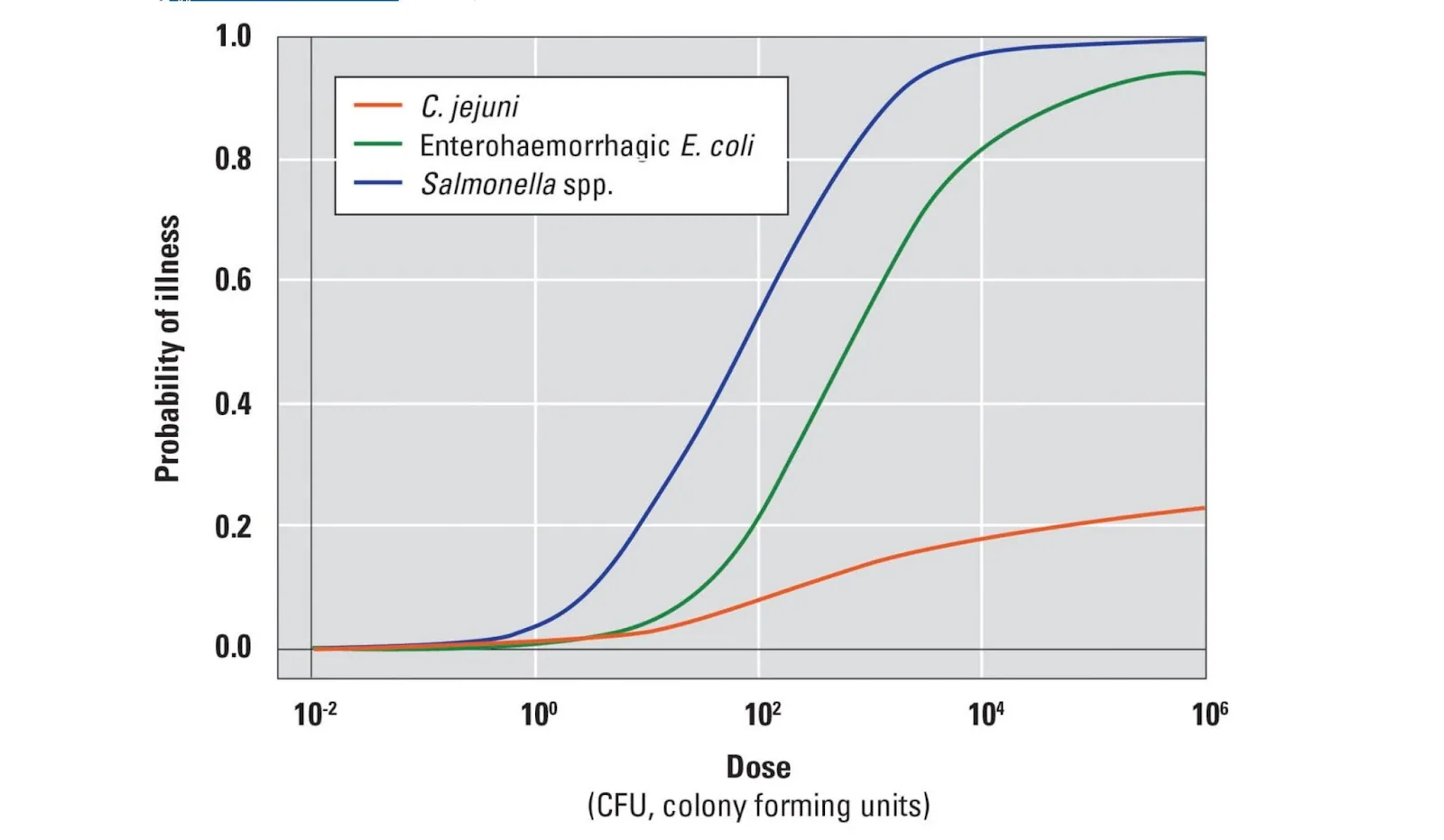
It considers the route of exposure — whether a pathogen is more likely found in prepared food or in tap water. It then looks at how much of that pathogen causes illness, compared with how much is likely to be ingested from the water supply. The result is a calculated risk level used to inform how governing bodies address pathogen levels in their regulations.
Data compiled by the Upper Midwest Water Science Center shows how different pathogens cause illness at markedly different levels of exposure.
Which pathogens are included in the QMRA?
All enteric pathogens pose risks to human health and should in principle be included in risk assessments, but that is unfeasible at present. The QMRA instead includes several reference pathogens, chosen to represent the behaviour and treatment response of similar organisms.
Bacteria. E. coli O157:H7 and Campylobacter are used as references. Both cause significant gastrointestinal illness, are prevalent in Canada, and respond to water treatment in a way similar to other bacterial pathogens.
Protozoa. Giardia and Cryptosporidium are the most common waterborne protozoan pathogens in Canada, with the potential to cause widespread disease. Their behaviour is well documented and they are a challenge to treat with conventional methods, which makes them good indicators of treatment effectiveness.
Viruses. Rotavirus is currently used as a reference for enteric viruses, though no single enteric virus has been found to be truly representative. Rotavirus has some features of a good reference — common, causes disease, well studied — but it is not perfect. Prevalence and strain type can be geographically dependent, and young children are often more susceptible to infection, which the QMRA does not consider.
Limitations to using the QMRA
While the model is thorough and has been adopted as standard practice internationally, it has significant limitations.
Some methods used to identify waterborne pathogens are outdated. More accurate detection has revealed surprising links between waterborne pathogens and public health that would previously have gone unreported. As understanding improves, assessments have to reflect it.
An ideal reference virus has historically been difficult to identify. Enteric viruses are particularly difficult to test for, difficult to treat, and can cause infection from ingesting just a few particles. Proper representation is required to estimate the risk accurately.
The QMRA also does not account for extreme weather. Heavy rainfall and warmer temperatures increase pathogen levels in source water, and the model does not consider that.
And while it is largely effective at preventing disease in healthy populations, it does not consider demographic data. Pregnant women, children, elderly people and those who are immunocompromised may be particularly vulnerable to some infections.
For these reasons, water scientists have been calling for the QMRA to keep pace as technologies develop and pathogen levels change.
Conclusion
Canada's approach depends on a combination of federal guidelines, provincial standards and municipal implementation, with the QMRA informing all of it. The system has been largely effective, but it faces challenges: outdated detection methods, difficulty identifying ideal reference viruses, and limited consideration of vulnerable populations. As understanding of waterborne pathogens evolves and new technologies emerge, there is a pressing need for the model and the regulations built on it to adapt.