

Why Legionnaires' cases peak from May to November, and what mitigates it
Legionella bacteria are a major concern for water systems, especially during the warmer months when conditions are right for them to grow. These bacteria, which cause Legionnaires' disease and Pontiac fever, thrive in man-made water systems and pose serious health risks when improperly managed.
What is Legionella?
Legionella occurs naturally in freshwater sources such as lakes and rivers, usually in concentrations too low to cause harm. When the bacteria get into man-made water systems like plumbing, they can multiply to dangerous levels under the right conditions. Inhalation of contaminated water droplets can lead to a deadly form of pneumonia. Not everyone exposed will become sick, but the potential for severe outbreaks is high in vulnerable populations such as older adults and those with weakened immune systems.
Seasonal patterns and risk factors
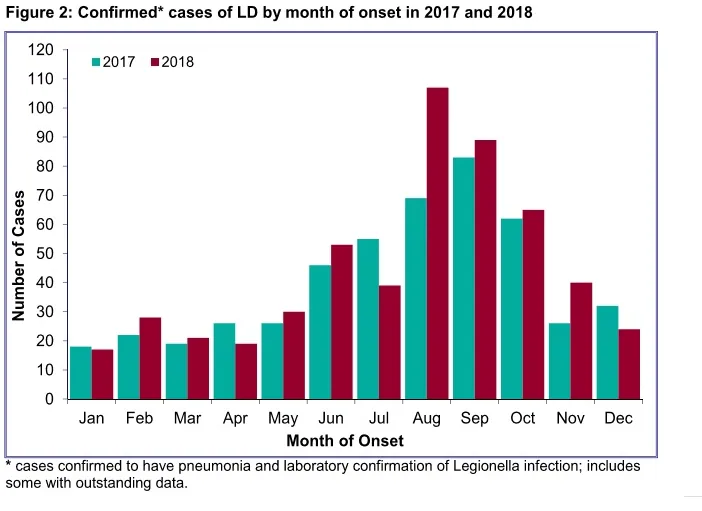
Legionnaires' disease cases often peak in summer and autumn, from about May to November, because Legionella thrives in warm water. Several factors influence the risk during warmer seasons.
- Temperature. Legionella multiplies rapidly between 20°C and 50°C (68°F to 122°F). In summer, plumbing systems, cooling towers and other man-made water systems often sit within that range.
- Water stagnation. Occupancy is often reduced during warmer months, so demand on water is lower, creating stagnant areas — dead legs — where Legionella thrives.
- Cooling systems and air conditioning. Cooling towers are a key component of air conditioning in large buildings and a prime site for growth. They may release contaminated droplets into the air, which is how outbreaks start.
The Connecticut Department of Public Health has collated data from recent years showing exactly this seasonality in Legionnaires' cases.
Climate change-associated risks
The significant increase in incidence at warmer temperatures leads naturally to the question of how rising global temperatures will affect prevalence. Legionella infections have been rising significantly over the past twenty years and are predicted to continue climbing.
Climate change is also driving an increased frequency of extreme weather — hurricanes, heavy rainfall, floods — which has a direct impact on urban water systems. Floodwaters can infiltrate normal water systems, carrying Legionella in and creating the stagnant, nutrient-rich environment ideal for growth. Damaged infrastructure leads to leaks and bursts, creating further opportunity for contamination.
Strategies to mitigate the risk
Effective prevention and maintenance are crucial to minimising the risk of contamination in large building water systems, particularly during peak seasons. A comprehensive approach — routine inspection, water temperature management and system flushing — significantly reduces the likelihood of an outbreak.
Routine inspections
Regular inspections are the cornerstone of a proactive strategy, allowing problems to be identified before they escalate. Inspections should focus on areas where water can stagnate: storage tanks, cooling towers and infrequently used fixtures. Any sign of corrosion, biofilm buildup or sediment accumulation should be addressed immediately.
Water temperature control
Maintaining water temperatures outside the optimal range for growth is another key measure. Legionella thrives between 20°C and 50°C, so keeping hot water above 60°C (140°F) and cold water below 20°C (68°F) inhibits it. Temperatures should be monitored and adjusted regularly, especially through seasonal changes. For hot water systems, periodic thermal disinfection — raising the temperature to 70°C or higher for short periods — is an effective way to eliminate any Legionella present.
System flushing
Stagnation and dead legs are common in large buildings, particularly during periods of low occupancy such as the summer months. Regularly flushing these areas circulates fresh, treated water through the system and reduces the opportunity for bacteria to multiply. Flushing should be done at all points of use, including seldom-used outlets and sections of pipe prone to stagnation. During periods of low occupancy, consider a more frequent schedule.
Recent severe outbreaks
London, Ontario, July 2024. An outbreak resulted in 25 confirmed cases, including one death, and 10 hospitalisations. Everyone infected lived or worked within five kilometres of each other in south London. The Middlesex-London Health Unit found Legionella in three cooling towers in that area.
Melbourne, Australia, 2024. An outbreak linked multiple cases to a contaminated cooling tower in the western suburbs, causing more than 100 cases of Legionnaires' disease, most of which required hospitalisation, and two deaths. The incident underlines the vulnerability of urban centres, especially during warmer seasons.
Conclusion
Legionella is a seasonal threat that needs careful management and proactive steps. Knowing when and where the bacteria are likely to grow, especially during the warmer months, is what keeps a water system safe. Regular monitoring, proper maintenance and effective disinfection go a long way toward reducing the risk. Now is the time to assess your water systems rather than after an outbreak.