

More than a bright light in a tube: what ultraviolet actually does to a cell
When you hear that ultraviolet light is a powerful disinfectant, it is more than just killing germs. How UV really works is much more nuanced. It works at the molecular level, interfering with the fundamental macromolecules that allow living organisms to function. From DNA to proteins, UV light takes aim at the building blocks of life and stops them in their tracks.
Biological weak spots: why UV works so broadly
UV disinfection is effective against nearly all types of biological contaminant — bacteria such as Legionella, viruses including enteric and respiratory strains, parasites such as Cryptosporidium and Giardia, spores, and fungi.
How is one technology so broadly effective? It comes down to the basic molecular machinery shared by all biological organisms: nucleic acids and proteins. These macromolecules store genetic instructions, regulate cell activity, build cellular structures and, critically, allow pathogens to replicate, infect and spread. UV light — especially medium-pressure UV — disrupts all of them.
Different wavelengths, different mechanisms
Not all UV is created equal. Low-pressure systems emit light at a single wavelength, 254 nanometres. That wavelength is highly effective at damaging DNA, and DNA is the main target.
Medium-pressure systems emit across a broad spectrum, roughly 200 to 300 nm. That allows multi-targeted damage: not just DNA, but RNA and proteins as well. The difference is why medium-pressure UV offers superior disinfection, especially in complex water systems where a variety of microorganisms and resistance mechanisms may be present.
DNA damage: the primary target
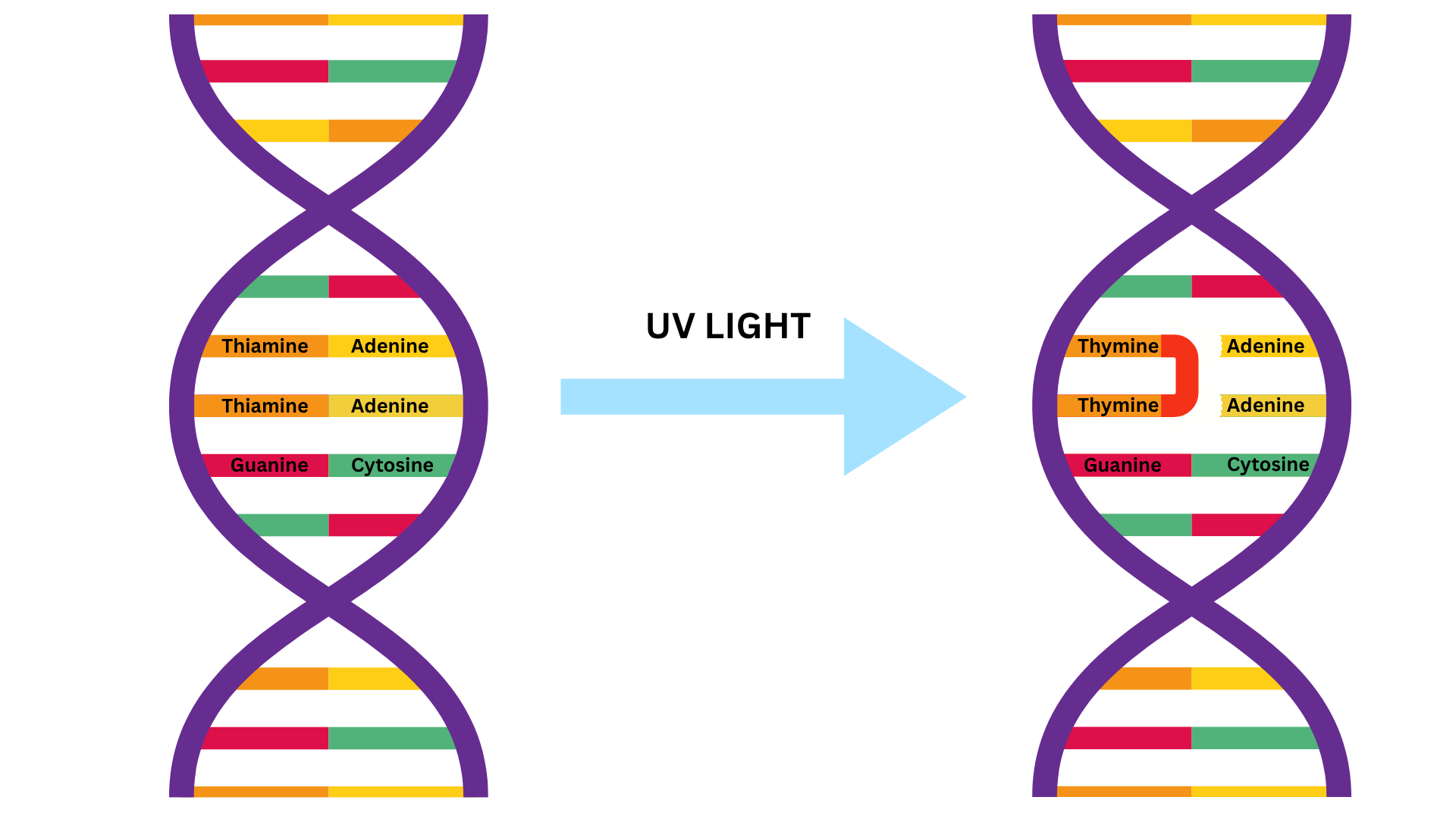
When a photon of UV light strikes DNA, the molecule absorbs that energy and immediately tries to release it as heat. During the infinitesimally brief moment while the energy is trapped, the DNA becomes highly reactive.
That reactivity leads to a specific chemical event called a pericyclic reaction. In simple terms, two adjacent DNA bases — usually thymine or cytosine — fuse into a structure called a dimer. Think of it as gluing two puzzle pieces together incorrectly: they will no longer fit where they should.
Why does that matter? DNA replication depends on precise base-pair matching. UV-induced dimers throw a wrench into that machinery. When the cell's enzymes try to read or copy the DNA, they misread the fused bases, make mistakes, or grind to a halt. That disrupts all of the cell's functions, especially reproduction. Under the high-intensity lamps used in water disinfection, millions of dimers form at once, and the cumulative effect is overwhelming.
An important distinction: UV does not destroy the cell immediately. The organism may remain physically present for a short time, but its ability to function is fundamentally compromised. In most cases the cell dies shortly after a strong dose, but that is secondary to the inactivation itself.
RNA: the secondary target
Many pathogens — especially viruses — rely on RNA rather than DNA to carry their genetic code. UV light disrupts RNA too. Like DNA, RNA absorbs UV energy, leading to base dimers, particularly between uracil and cytosine.
UV can also trigger irreversible RNA-protein crosslinks. Think of this as a chemical glue binding RNA to the proteins it interacts with, preventing proper transcription or translation. These lesions stop RNA viruses replicating or hijacking host cells.
Protein damage: unique to broad-spectrum UV
Unlike low-pressure systems, medium-pressure UV includes shorter wavelengths below 240 nm, which are especially damaging to proteins. Proteins absorb UV strongly in this range, and the consequences are significant.
- Denaturation. UV exposure breaks the delicate bonds maintaining a protein's three-dimensional shape. Once that shape is lost, the protein can no longer perform its function.
- Disruption of enzymes. Enzymes are the workhorses of the cell, and many pathogens rely on enzyme activity to infect hosts or reproduce. UV-induced damage disables them.
- Structural damage. Proteins in cell membranes or viral envelopes are disrupted, compromising the structural integrity of the organism.
This complements DNA and RNA disruption, creating a multi-pronged attack that is especially effective at high doses or against resistant microorganisms.
Oxidative stress: collateral damage with serious consequences
UV light also causes indirect damage through the creation of reactive oxygen species. UV energy excites certain molecules in the cell — water, dissolved organics — and those excited molecules generate unstable compounds including superoxide, hydrogen peroxide and hydroxyl radicals.
Reactive oxygen species are molecular wrecking balls, stealing electrons from other molecules and creating a cascade of damage. The condition is called oxidative stress, and it contributes to further degradation of biological molecules, compounding the UV-induced damage. It is a form of biochemical chaos that makes recovery almost impossible.
Why this matters for building-scale water safety
Understanding these mechanisms explains why UV is so effective as a point-of-entry solution for large buildings. It targets all forms of life regardless of species or structure. It is chemical-free, so there are no harmful byproducts. Medium-pressure UV provides multi-targeted inactivation, making it suited to resistant or complex microbial loads. And it is especially effective in ageing infrastructure, where biofilms and microbial contamination tend to hide.
Applied at the point where water enters a building, UV acts as a biological firewall, stopping pathogens before they can circulate.
Conclusion: harnessing light to disable life
UV disinfection may look simple on the surface, but it is more than a bright light in a tube. By damaging DNA, RNA and proteins, and inducing oxidative stress, it halts the essential life processes of microorganisms. They may still exist briefly, but they can no longer function or infect.
As more buildings face water quality challenges from ageing infrastructure, climate change and microbial resistance, understanding the science behind UV disinfection helps us design smarter, more resilient and safer water systems.