
What is lurking in your building's water?
When you think about water safety, Legionella probably is not the first thing that comes to mind. Yet this sneaky bacterium is more common — and more dangerous — than many realise. Here is what Legionella is, and why it is a bigger and more complex problem than you might think.
What is Legionella?
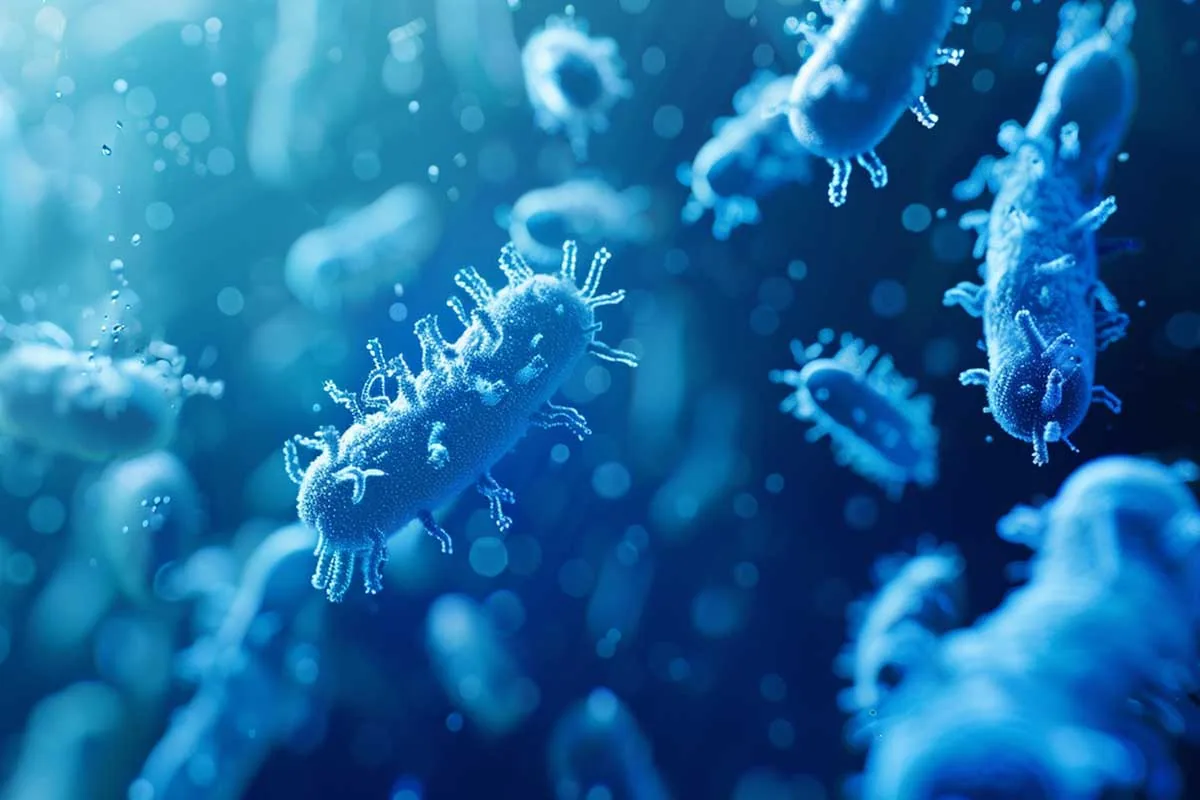
Legionella is a type of bacteria that naturally lives in freshwater environments like lakes and streams. Normally these bacteria do not pose much of a threat. But when they find their way into artificial water systems — cooling towers, hot tubs, plumbing systems — they can multiply and spread, causing serious health issues.
The bacteria can cause Legionnaires' disease, a severe form of pneumonia, and Pontiac fever, a milder flu-like illness. Legionnaires' disease can be particularly deadly, especially for the elderly, smokers, and people with weakened immune systems. The fatality rate is about 10% for otherwise healthy people, but reaches a staggering 25% for people with underlying conditions.
A common misconception is that consuming water with Legionella is what makes you sick. Rather, it is the inhalation of contaminated water droplets that actually causes Legionnaires' disease or Pontiac fever. People usually contract these illnesses from showers or hot tubs, when warm, vaporised water droplets containing Legionella are inhaled.
Where does Legionella come from?
Legionella is a naturally occurring bacteria in freshwater sources. In these habitats it exists in low numbers and poses no health risk. The real threat happens when the bacteria start to multiply to high numbers. So what causes that to happen?
Artificial, man-made water systems often create the perfect conditions for Legionella to multiply rapidly: warm temperatures, stagnant water, and the right nutrients. Cooling towers, hot tubs and decorative fountains all supply that combination.
Why is Legionella a problem?
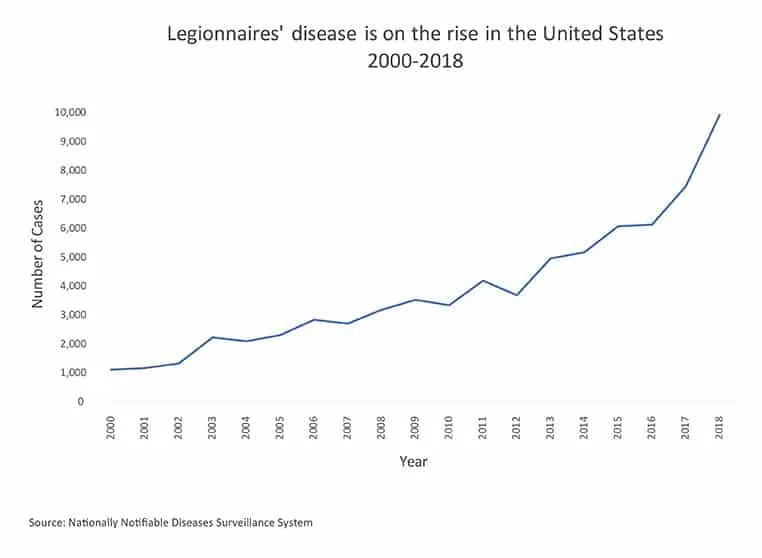
In 2018 the CDC reported approximately 10,000 cases of Legionnaires' disease. Experts believe the actual number is much higher — possibly up to three times more — because the disease is so frequently underdiagnosed and underreported. It is easily mistaken for other forms of pneumonia, so many cases go undiagnosed.
The CDC also reports that cases have been increasing at an average rate of 9% per year, pointing to a dangerous trend in prevalence. Since 2000 the number of cases in the US has increased tenfold, with a sharp upward trend since 2016. The reasons for that increase are not clear, but there are a number of possible factors.
One strong contender is ageing plumbing. Legionella multiply at high rates within biofilms — sticky layers of mucus produced by bacteria when they accumulate on moist surfaces. Ageing pipes are especially prone to biofilm formation, leaving them susceptible to Legionella growth and creating a major health risk. Water infrastructure throughout the US is aged and in need of replacement in many regions, which increases the risk over time.
Legionella outbreak: New York City, 2015
In the summer of 2015 the Bronx experienced one of the most significant outbreaks of Legionnaires' disease in recent history: 138 reported cases and 16 deaths. Officials were initially puzzled, as there were no common buildings visited by all the patients and those affected lived across a fairly large area. Investigators then began looking at outdoor exposure from cooling towers as a possible source.
The Opera House Hotel cooling tower was eventually identified as the source. These towers emanate warm mist, which can spread Legionella, and the hotel's tower had not been properly maintained. The event highlighted the severe consequences of neglecting water system maintenance, and spurred immediate regulatory action.
Following the outbreak, New York City implemented stringent regulations. The new rules required the registration, regular inspection and maintenance of cooling towers. Building owners must adhere to a rigorous schedule of cleaning and disinfecting, and must report any Legionella test results to the city. New York was the first city in the United States to implement legislation specific to the prevention of Legionella in building water systems.
Conclusion
Legionella might not be on everyone's radar, but it should be. The bacteria's ability to thrive in the water systems common to large buildings makes it a hidden threat to public health. By understanding the risks and implementing strong preventative measures, we can keep water systems safe and protect the people who rely on them.